Will My Sofa Fit in My Room?
It fits when the sofa goes in the room, the coffee table has somewhere to go, people can walk past and the delivery can get through the door.
Your sofa fits if its width and depth go into the room and you still have about 45 cm (18 in) between it and the coffee table, at least 60 to 70 cm (24 to 28 in) to walk past it, and a doorway and hall it can be carried through. Most sofas are 160 to 240 cm (63 to 94 in) wide and 85 to 100 cm (33 to 39 in) deep, so measure the one you want, arms included.
Start With the Sofa's Real Size
Take the width at the widest point, which is usually the arms, not the seat. A rolled arm can add 10 to 15 cm (4 to 6 in) to what a listing calls the width. Then take the depth, and write down the height if the sofa will go under a window.
Most sofas run 160 to 240 cm (63 to 94 in) wide and 85 to 100 cm (33 to 39 in) deep. A corner or L-shaped sofa runs larger, typically 240 to 300 cm (94 to 118 in) along its longest run, and needs its return counted as floor space too.
Room Fit: Leave the Room Usable
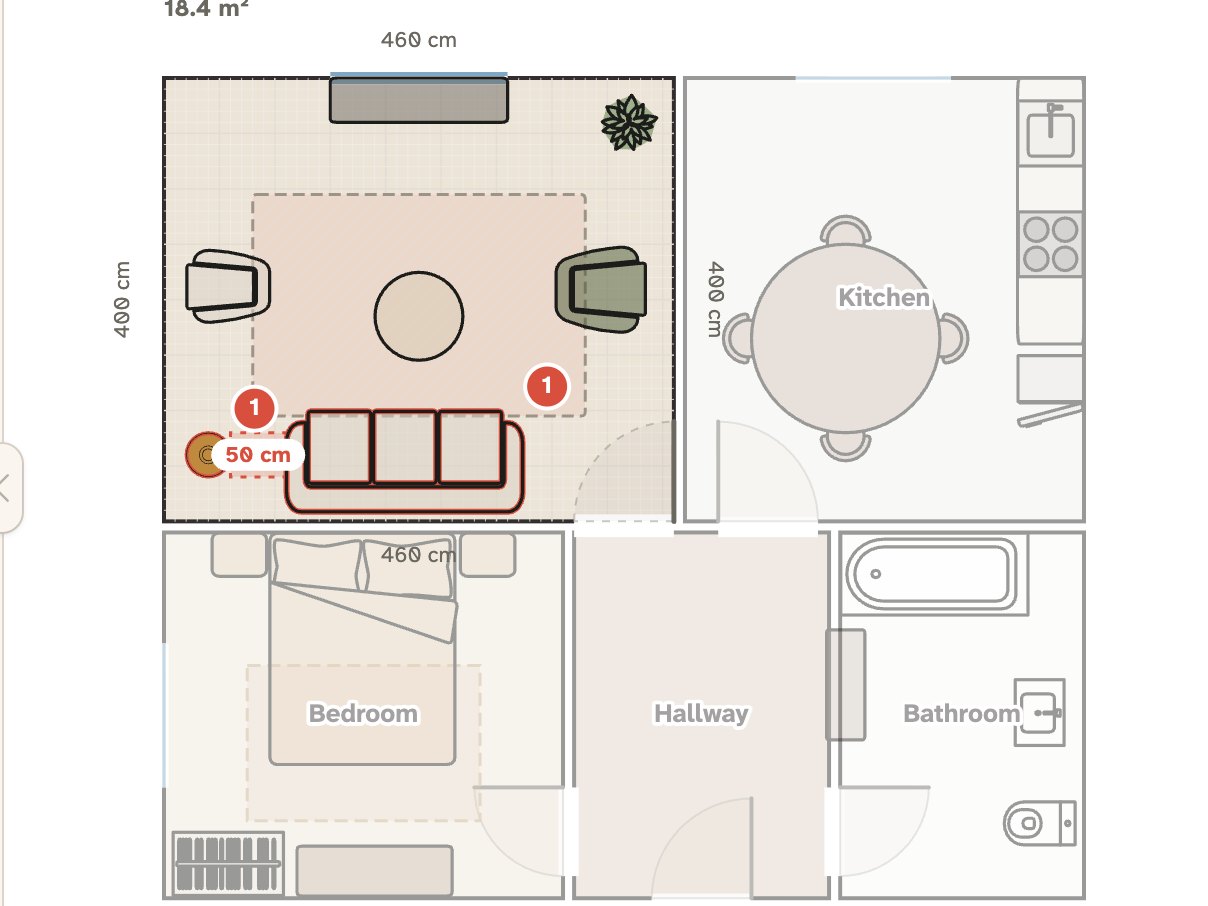
The sofa has to fit the wall, but the room also has to still work. Work out where the sofa will stand, then look at what is left: a path to the other side of the room, space to open windows and doors, and room for the rest of the furniture.
A good test is to draw the sofa and the walkway side by side. If the gap between the end of the sofa and the next wall is under 60 cm (24 in), people will be edging past it every day.
Sofa Clearance and the Coffee Table
The space between the sofa and the coffee table decides whether the seating is comfortable. 30 cm (12 in) is the least that works, 45 cm (18 in) is comfortable, and past about 60 cm (24 in) you have to lean forward to reach it.
A coffee table is usually 90 to 130 cm (35 to 51 in) wide and 55 to 75 cm (22 to 30 in) deep. About two thirds of the sofa's length is the proportion that looks deliberate rather than accidental. See coffee table spacing for the full numbers.
Doorway and Access
Nooked checks that a sofa does not block the swing of a door once it is in the room, and you can put doors and windows on your floor plan to see exactly where they open.
Getting the sofa into the room is a separate measurement that Nooked does not do for you, and it is where sofas most often fail. A sofa frame does not bend, so what has to clear the tightest point is often its diagonal, not its width. Measure these and the smallest number is your answer:
- The door's clear opening, inside the frame. The frame usually takes 5 to 8 cm (2 to 3 in) off what you thought you had.
- The same opening with the door off its hinges. Free, and often the difference.
- Every corner the sofa has to turn, where the diagonal is what counts.
- The stairs: the narrowest point, and the headroom over the turn.
- The elevator car and the elevator door, separately. They are rarely the same size.
What a Sofa Listing Usually Leaves Out
Four measurements decide whether a sofa is comfortable, and they are rarely in the headline figures:
- Seat height. Around 45 cm (18 in) suits most people. 38 cm (15 in) is a lounger and hard to get out of.
- Seat depth. The difference between sitting and reclining, and whether your feet reach the floor.
- Arm width. A 220 cm (87 in) sofa with 25 cm (10 in) arms gives you 170 cm (67 in) of actual seat.
- Whether the legs come off. Usually 10 to 15 cm (4 to 6 in) of height, which is sometimes exactly the margin you need at the door.
If It Does Not Fit
A sofa that fails at the door is usually rescued by a different model, not a different room. Modular and knock-down sofas arrive in pieces and are put together where they stand. A slim-arm or armless model gives back 20 to 50 cm (8 to 20 in) of width for the same seat.
If it fails on the wall instead, a two-seater plus an armchair often seats the same number of people in a shape a straight three-seater cannot.
See It in Your Room Before You Buy
Paste the link to the sofa you are looking at and Nooked reads its size from the page. Place it on your floor plan next to the coffee table, the rug and the rest of the furniture, at real scale, and see which gaps are too tight before anything is ordered.
Common questions
- How do I know if a sofa or couch will fit in my living room?
- Measure the sofa's width, depth and arms, draw the room to scale, and place the sofa where it will stand. Check that you keep about 45 cm (18 in) to the coffee table and at least 60 to 70 cm (24 to 28 in) to walk past, and that it does not block a door.
- How much space should be between a sofa and a coffee table?
- 45 cm (18 in) is comfortable, and 30 cm (12 in) is the least that works. Past about 60 cm (24 in) the table is hard to reach from the sofa.
- How wide is a typical sofa?
- Most sofas are 160 to 240 cm (63 to 94 in) wide and 85 to 100 cm (33 to 39 in) deep. A corner or L-shaped sofa is typically 240 to 300 cm (94 to 118 in) along its longest side.
- Will a three-seater sofa fit in a small living room?
- A three-seater is typically 200 to 230 cm (79 to 91 in) wide, so it wants about 240 to 260 cm (94 to 102 in) of clear wall to look placed rather than wedged. In a room 3 m (10 ft) across that usually means the long wall, and where the door is matters more than the room's total area.
- Is a corner sofa harder to fit than a straight one?
- To get in, usually easier, because most corner sofas are modular and arrive in sections. To place, harder: a corner sofa takes two walls instead of one.
- Will a sofa fit through my door?
- Compare the door width, hall and stairs with the sofa's depth and height, since it is often carried on its end. Nooked does not check delivery routes, but it does check that the sofa does not block a door's swing in the finished room.
Check your sofa at scale in Nooked
Nooked is a furniture fit checker and decision tool that lets shoppers place real furniture at real scale before buying. Compare finds from different stores and build a moodboard of pieces that fit together in size and style.