Moving Tips: How to Pack and Label So Unpacking Is Easy
Small habits while packing that save hours at the other end
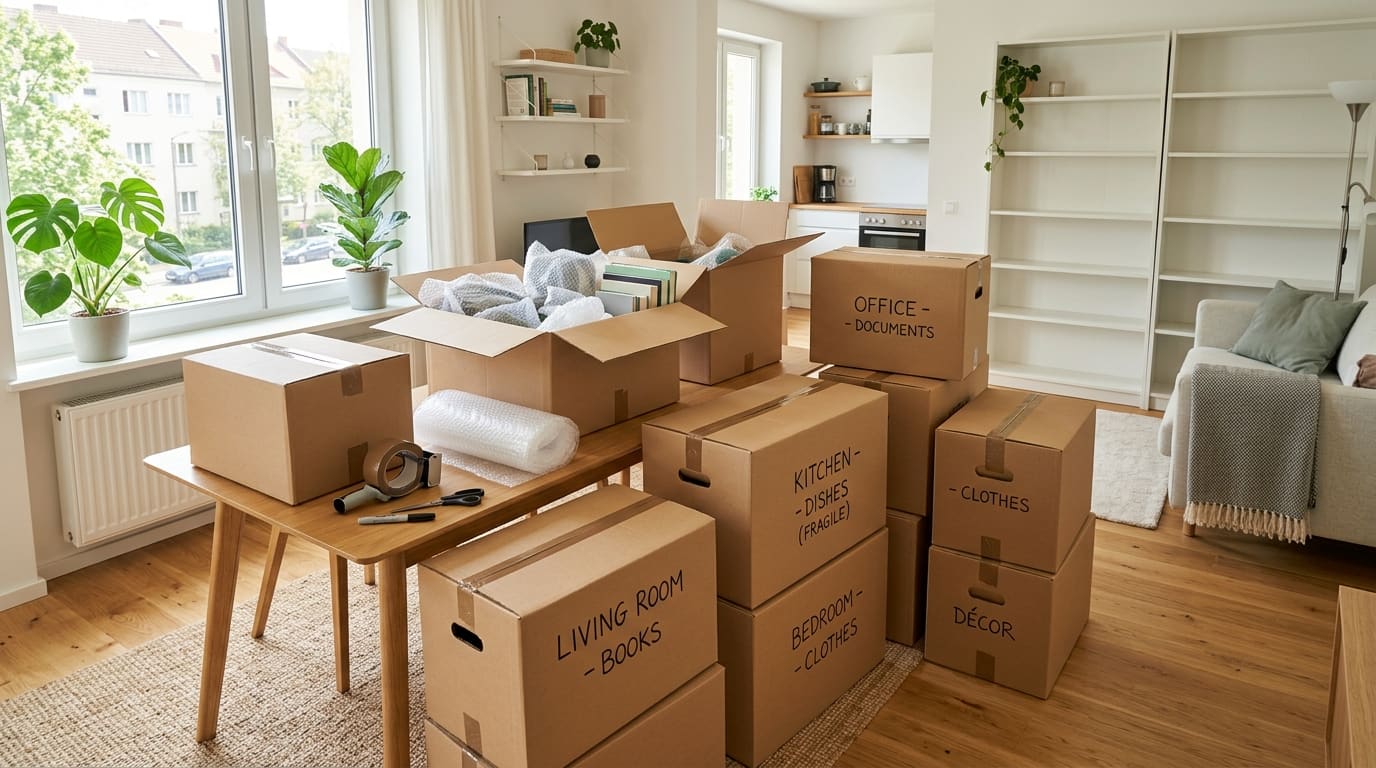
Packing is the part of a move everyone thinks about. Unpacking is the part that decides how the first week feels. Most of these tips cost a few seconds per box while you pack, and pay off when you are standing in the new apartment looking for the coffee maker.
Labeling
Write the room it is going to, not the room it came from. The new apartment may not have the same rooms. "Study" is more useful than "spare room" if the spare room is becoming a study.
Use one color of tape per room. Blue for the bedroom, green for the kitchen, and so on. Anyone carrying a box can see where it goes without reading.
Put the label on the side, in the same corner every time. Once boxes are stacked, the top is hidden. Two sides is better than one.
Put the same color on the door of each room in the new place. Do this before the first box comes in. Helpers and movers then do not need to ask you anything.
Say what is inside, specifically. "Kitchen" tells you the room. "Kitchen: mugs, kettle, coffee" tells you which box to open first.
Number the boxes per room. "Kitchen 4 of 6" means you know on the day if one is missing, and which.
Mark fragile boxes on the sides as well as the top, along with which way is up.
Mark the boxes to open first. A star or the word "first" on the handful of boxes you need on day one.
Packing
Start with what you use least. Books, out-of-season clothes, decorations, the back of every cupboard. The things you use daily go last.
Pack one room at a time. Mixed boxes are quick to pack and slow to unpack.
Heavy things in small boxes, light things in large ones. A large box of books is the one that breaks, or that nobody can lift.
Fill every box to the top. Half-empty boxes get crushed when stacked. Fill gaps with towels or clothes.
Use what you own as padding. Towels, bedding and sweaters protect plates and glasses, and they need moving anyway.
Pack plates on their edge, like records, with something soft between them. They take knocks better that way than in a flat stack.
Leave clothes in the drawers. Take the drawers out, wrap each one, and carry it as a box. The dresser itself is lighter to carry empty.
Keep clothes on their hangers. Put a trash bag over a bundle of them from the bottom and tie it around the hooks.
Bag anything that can leak, such as cleaning products and toiletries, and pack it upright.
Use suitcases for the heaviest things. They have wheels.
Furniture
Measure your large pieces before the move. Width and depth of the sofa, bed, wardrobe, table and desk. You need the numbers to check the new rooms, and again to choose a truck.
Decide where each large piece goes before moving day. With a plan of the new rooms, each piece is carried once, straight to its place. Without one, the sofa goes down wherever there is space and gets moved again later, around forty boxes. Will my furniture fit in my new apartment? shows how to make that plan.
Take a photo before you take anything apart. And a few more as you go. Putting a bed frame back together from memory is harder than it sounds.
Put screws and fittings in a labeled bag and tape it to the piece. Under the tabletop, inside the wardrobe, on the bed slats. A box of mixed screws from five pieces of furniture is a puzzle nobody wants.
Take the legs off tables and sofas if they unscrew. A few inches can be the difference at a doorway.
Protect the corners. Corners of furniture and corners of walls are what get damaged. Blankets, cardboard or towels will do.
Measure doorways diagonally too. A tall bookcase or a mattress often goes through tilted when it will not go through upright.
Mark the footprint on the floor. If you have the keys early, painter's tape on the floor of the new room shows exactly where the bed or sofa will stand, for you and for whoever is carrying it.
Cables and electronics
Photograph the back of the TV, router and computer before unplugging anything.
Label both ends of each cable, or bag each device with its own cables and remote.
Keep the router and its cables in the first-night box, if your internet is already connected at the new place.
The first-night box
One box, or one bag, that travels with you and not in the truck. It holds what you need before anything else is unpacked:
Keep documents, keys, medication, laptops and anything valuable with you as well.
On the day
Load the things you need last, first. What goes into the truck first comes out last. The bed and the first-night boxes go in at the end.
Have large furniture carried in before the boxes. It is much easier to place a sofa in an empty room.
Stack boxes along one wall of each room, labels facing out, and keep the middle of the floor clear.
Make the bed first. Whatever state the rest is in, you have somewhere to sleep.
For what to do in the weeks around the move, from giving notice to the first week, see the moving apartment checklist.
Related guides
All guides